From Foam to Chant: The Mascots That Have to Earn a Nickname
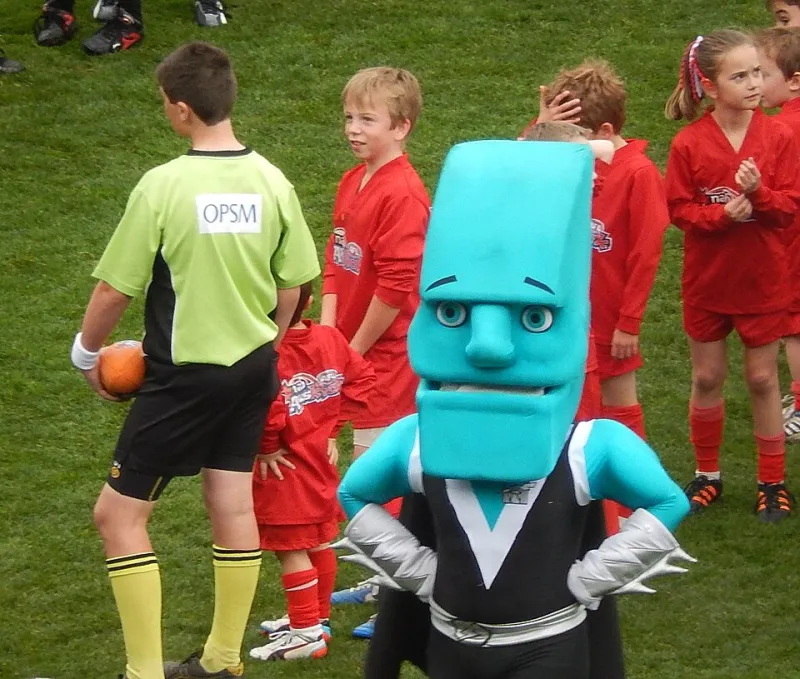
Photo: Michael Coghlan from Adelaide, Australia, CC BY-SA 2.0, via Wikimedia Commons
There is a moment, usually around 2.45pm on a wet Saturday, when a club's nickname stops being a word on a badge and becomes a bloke in a foam head trying to high-five a steward. The mascot is the alias in physical form: the Shrimper, the Hornet, the Swan, the Blade. It is the most visible custodian a nickname has, and the least subtle. But here's the thing — a suit can keep an alias alive, sand off its edges, or get it spectacularly wrong. The terrace, as ever, has the final say.
The Suit as a Nickname's Loudest Advert
Some mascots are basically a nickname with legs. Southend United's Sammy the Shrimp is a giant crustacean doing the rounds at Roots Hall — a humble alias made flesh, or at least made foam. Swansea City's Cyril the Swan took the Swans nickname and gave it a mischievous streak, a mascot with a reputation for mischief that occasionally boiled over into touchline scraps and a red card or two. Watford's Harry the Hornet turned the Hornets into a wind-up merchant, most famously with a spot of theatrical diving that got under the skin of the away end. In each case, the suit did not invent the nickname. It just gave it a face, a gait and a half-time routine.
That is the mascot's real job: to be the nickname's travelling salesman. A child in the family stand who has never heard the word 'Shrimpers' in conversation will still point at Sammy and shout it. The alias gets passed on through a furry handshake.
When the Suit Sanitises the Alias
The trouble starts when the costume smooths off everything that made the nickname interesting. Manchester United's Red Devils became Fred the Red, a cuddly red chap with a grin and a drum. Arsenal's Gunners became Gunnersaurus, a dinosaur who has nothing to do with artillery but somehow became beloved anyway. Neither is a crime. But you can feel the edges being rounded. The devil loses his menace; the gunner becomes a green lizard with a gentle wave.
Sometimes the sanitisation is the point. A club cannot send a real devil or a real firearm into the family stand. The mascot is the acceptable, licensable version of the alias — the nickname after a risk assessment. It keeps the word alive in the club shop, but it also tells you what the club thinks the word is allowed to mean. Whether the terrace accepts that version is another matter.
The Mismatch Problem
Then there are the mascots that ignore the nickname altogether. Preston North End's Deepdale Duck is a fine duck, but the club's aliases are the Lilywhites and North End — no duck in sight. Oldham Athletic's Chaddy the Owl comes from the crest rather than the Latics nickname. These characters can still be loved, but they are not really carrying the alias. They are carrying the badge. There is a difference, and the terrace knows it.
A mascot that gets the nickname plainly wrong — a random animal for a club named after a trade, a cuddly toy for a side known for something sharper — is not a disaster. It is just a missed open goal. The suit had one job: to be the nickname's most visible custodian. If it turns up as a generic bear, the alias has to fend for itself.
The Terrace Verdict
The family stand may love the mascot, but the away end decides whether it earns a chant. A mascot that takes itself too seriously gets the 'you fat bastard' treatment. A mascot that leans into the joke — the half-time penalty, the mascot race, the willingness to be clattered by a steward in a bib — gets a song of its own. Cyril earned his reputation by being game. Harry earned his by being a pest. Sammy earns his by simply existing in a division where shrimp-related joy is in short supply.
The nickname's copyright still sits with the people on the terraces. The club can zip a custodian into a suit and send it out at 2.45pm, but it cannot force the chant. That has to be earned, usually by falling over in front of the away end and getting up with a wave.
What Makes a Mascot Earn Its Place
It is rarely the costume budget. The best mascots are the ones that understand they are a figure of fun first and a brand ambassador second. They do the Sunday league shuffle, they pose for the photo, they take the mockery. When a mascot does that, the nickname gets a second life — not just on the badge, but in the family stand and the away-end chant.
So next time a foam-headed legend waddles past the corner flag, give it a look. Is it keeping the alias alive, softening it for the club shop, or pretending the nickname never existed? The answer is usually in the song, or the silence. The suit is only the custodian. The terrace still holds the keys.