The Names That Only Travel by Train: Away-End Aliases and Why They Vanish
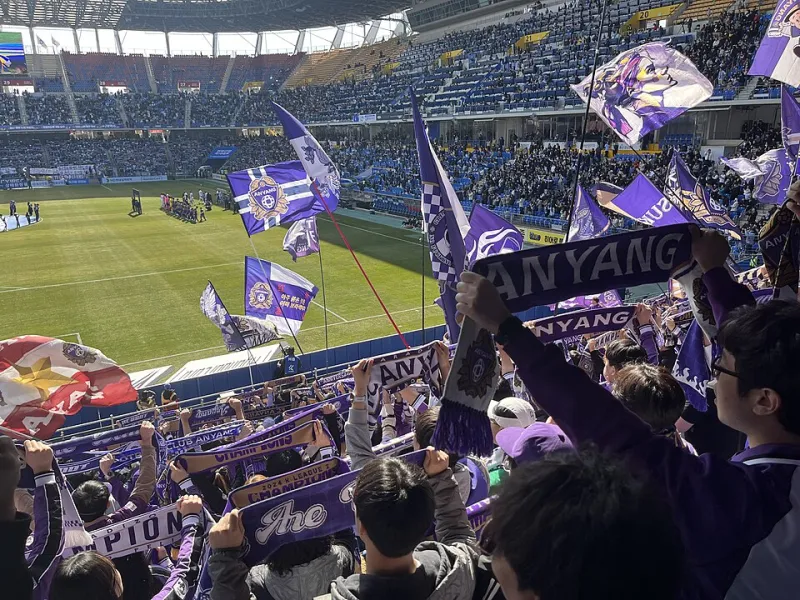
Photo: Haena96, CC BY 4.0, via Wikimedia Commons
The version of your club that never gets a press release
There is a version of every football club that exists only in a rattling train carriage, a motorway service station and the back rows of a borrowed stand. It has its own names for players, its own names for rivals and sometimes its own name for itself. None of it appears on the badge. None of it is in the club shop. Most of it would make the media officer wince.
These are the away-end aliases: the terrace names that live in the gaps between official history and fan folklore. They are not the same as club nicknames. They are smaller, sillier and more disposable. They can be affectionate, brutal or simply bizarre. And in 2026, with every away day filmed and posted before the full-time whistle, they are still somehow managing to stay just out of reach.
A nickname needs a witness, not a marketing meeting
Away-end names are not designed. They are accidents that get repeated. A player miscontrols a ball into a puddle and becomes 'The Anchor'. A substitute warms up in a coat two sizes too big and is 'The Skip' for the rest of his career. A rival defender has a haircut that looks like a dropped pie and, for 90 minutes, that is his entire identity.
The crucial ingredient is not wit. It is audience. A name needs enough people to hear it, laugh and pass it on. It needs to fit the rhythm of the stand. It needs to be shoutable after a pint and memorable after a defeat. If it needs explaining, it is already dead.
That is why so many away-end aliases are born on the road rather than at home. The away end is a smaller, stranger room. The usual faces are mixed with the once-a-season travellers. The songs are louder because there are fewer distractions. A name that might get lost in a home crowd of 40,000 can take root in a corner of 1,800.
The three species of terrace alias
Most of them fall into three rough families. The first is the sarcastic name: the striker who has not scored since August being called 'The Goal Machine' with heavy irony, or a centre-half who hoofs it into the roof being christened 'The Architect'. These names are a pressure valve. They let fans criticise without turning toxic. They are jokes with a bite.
The second is the affectionate name: the cult hero who runs through a wall, the left-back with a name nobody can spell, the goalkeeper who once saved a penalty at a ground that no longer exists. These names are warmer, but they still belong to the fans rather than the club. They are not marketing slogans. They are earned.
The third is the short-lived name: the one that lasts for one away trip because of a single incident, a weird shirt, a missed train or a chants that went wrong. These are the mayflies of terrace culture. They are rarely written down. They are often the funniest.
Why some names stick for decades
Stickiness is a mystery. A name can have everything — humour, timing, a memorable away end — and still vanish by the next home game. Another name can be objectively nonsensical and survive for 30 years. The ones that last usually share three things: they are easy to say, they belong to a shared story and they do not need the club's permission.
There is also the matter of silence from above. The moment a terrace name appears on a club's social media feed, it starts to die. It becomes official. It becomes a bit. The away end can smell a manufactured nickname from the other side of the country. The best ones survive because nobody in power has noticed them yet.
The internet has not killed the away-end alias
The obvious fear is that everything is documented now. Phones are out. Chants are filmed. A new name can be on a rival's timeline before the train home. But the away end has adapted. The name still lives in the moment. The clip is just a receipt.
What the internet has done is create a second life for the names that might otherwise have disappeared. A player can be 'The Fridge' for one season in the stand and then become a minor legend online years later. The alias does not need to be official to be remembered. It just needs one person to keep telling the story.
Send us the names you have heard in 2026
This is where you come in. We want the away-end aliases that have been doing the rounds in 2026: the player nicknames, the stand nicknames, the names for a cursed away trip, the ones that make no sense outside a five-mile radius of the ground. Send them to Footy Nicknames with the club, the context and, if you can remember, the away end where you first heard it.
The badge and the club shop will always have their version of your club. The away end has another one. It is louder, funnier and much less likely to be trademarked. Long may it stay that way.